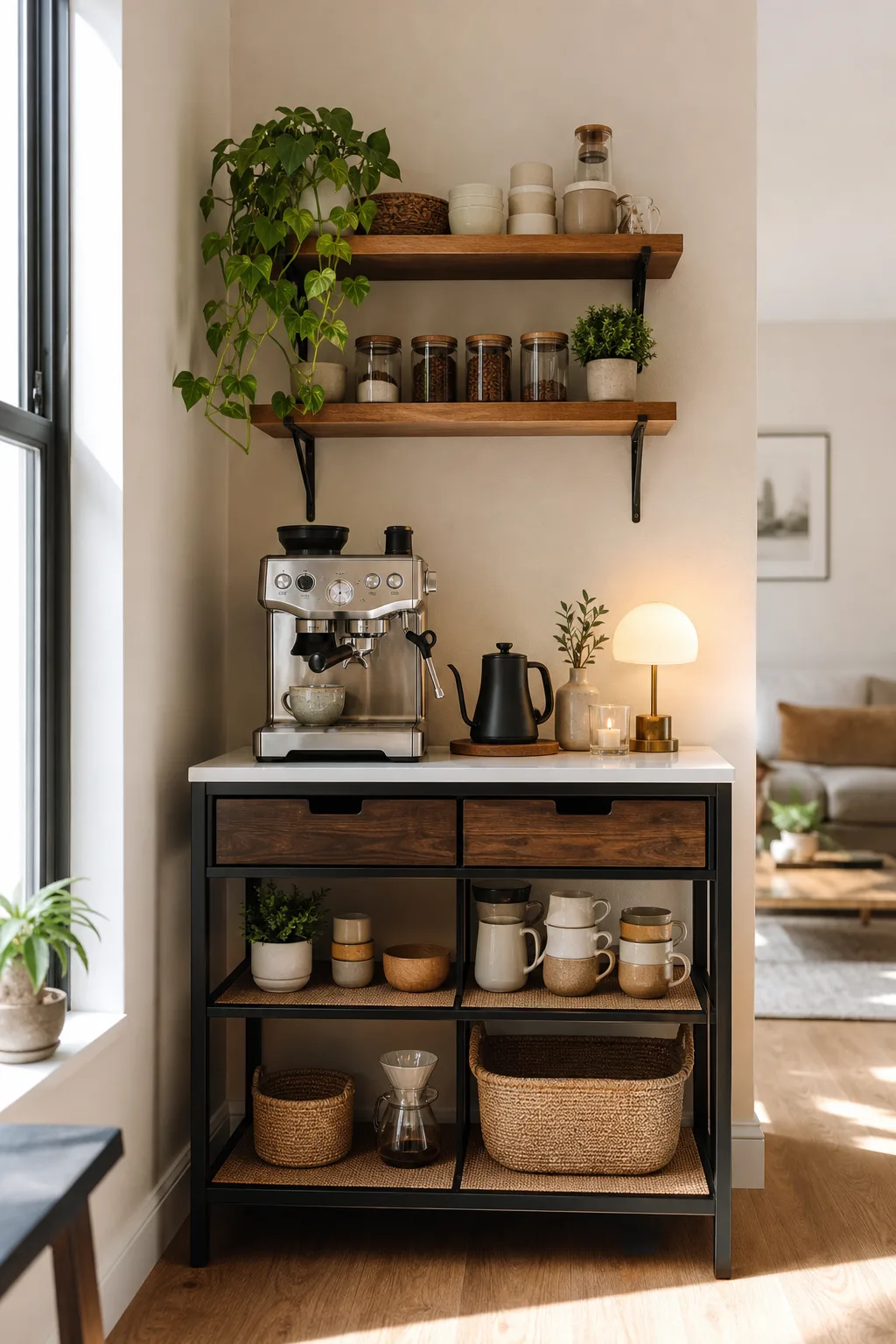
Spaces
Minimalist Coffee Corner Setup Guide
A minimalist coffee corner is the smallest setup that completes your real brewing sequence without borrowing space from unrelated kitchen work.

A minimalist coffee corner is the smallest setup that completes your real brewing sequence without borrowing space from unrelated kitchen work. Start with one brewer, one daily cup, current coffee, the required filter or scale, and one cleaning cloth. Store backups elsewhere.
Define the finished workflow
Write the steps from water to cleanup. A simple drip sequence may be fill, measure, brew, pour, discard grounds, and wipe. Espresso adds grinding, dosing, locking the portafilter, steaming, and purging. Matcha needs sifting, mixing, and rinsing.
Every object on the counter should support one of those steps. If it serves only future guests, seasonal drinks, or photography, move it to secondary storage.
Measure the operating box
Place the appliance on the proposed surface and measure more than its footprint:
- lid or reservoir opening above;
- portafilter or carafe movement in front;
- steam-wand or kettle movement at the side;
- distance to the sink without crossing a walkway;
- access to the outlet without stretching the cord;
- clearance required by the manufacturer.
Mark the box with painter’s tape before buying a tray or shelf. A compact appliance can still fail beneath a low cabinet if its water lid cannot open.
Build three zones, not three shelves
Work zone
Keep only the brewer, grinder if required, scale, and the cup currently in use. Leave one clear patch for filling or tamping. Negative space is functional here: it gives hot and wet tools a safe landing.
Supply zone
Keep a week’s coffee and the filters or tea strainer used every day. Use the original coffee bag if it closes well; matching canisters are optional. Put unopened bags, alternate syrups, and guest mugs in a cabinet.
Reset zone
Give the cloth, brush, and waste route a fixed place. The route may be a trash can below the counter rather than another container on top. Cleaning succeeds when it is shorter than leaving the mess.
Choose one containment tool
A tray is useful when it catches grounds and lets you move several small items together. A drawer insert is better when the counter already has a hard boundary. A narrow cart works when floor storage is available but counter space is not.
Do not stack a tray, riser, mug tree, and shelf simply to make the corner look organized. Each layer consumes operating room and creates another surface to clean.
Remove visual noise without hiding the process
Keep labels facing one direction, limit the daily cup to one or two, and choose a single container only when packaging cannot stand neatly. Route the cord behind the appliance without pinching or tightly coiling it.
Do not solve an outlet problem with an arbitrary extension cord. The US Consumer Product Safety Commission warns that extension cords missing required safety characteristics can present shock or fire hazards. Follow the appliance manual and use an appropriate permanent outlet location; ask a qualified professional or property manager when the setup requires electrical changes.
A 20-minute reduction test
- Remove everything from the coffee area.
- Brew one normal drink, returning each necessary item to the counter as you touch it.
- Clean the setup completely.
- Photograph or list what remained unused.
- Store unused items elsewhere for one week.
After the week, restore only an item whose absence caused repeated friction. This separates a real tool from an object that merely belongs to the coffee theme.
Three complete minimalist setups
Drip coffee
- compact coffee maker;
- current bag of coffee;
- filters if required;
- measuring scoop or scale;
- one mug;
- cleaning cloth.
Manual pour-over
- kettle and dripper;
- filters;
- coffee and grinder, if grinding at home;
- scale;
- server or mug;
- rinse/drying route.
Espresso
- machine and compatible grinder;
- portafilter, basket, supplied tamper, and pitcher;
- scale if it fits the tray;
- current beans;
- steam-wand cloth and required cleaning tool.
These lists are starting boundaries, not shopping lists. If the machine includes a tool, use it before buying a duplicate.
The nightly reset
Discard grounds, rinse the parts required by the manual, wipe milk residue promptly, return coffee to its storage place, and leave the work patch clear. Refill water or stage filters only when the appliance instructions allow it.
Once a month, remove any item not used since the last review. Minimalism is not a beige color palette; it is a setup whose footprint and inventory remain accountable to the drink.
Source

Continue reading