
Equipment
Apartment Coffee Setup Guide
The right apartment coffee setup starts with the drink you make most often—not with a long equipment wish list. Choose one of three paths: - Manual coffee: smallest footprint and easiest storage.
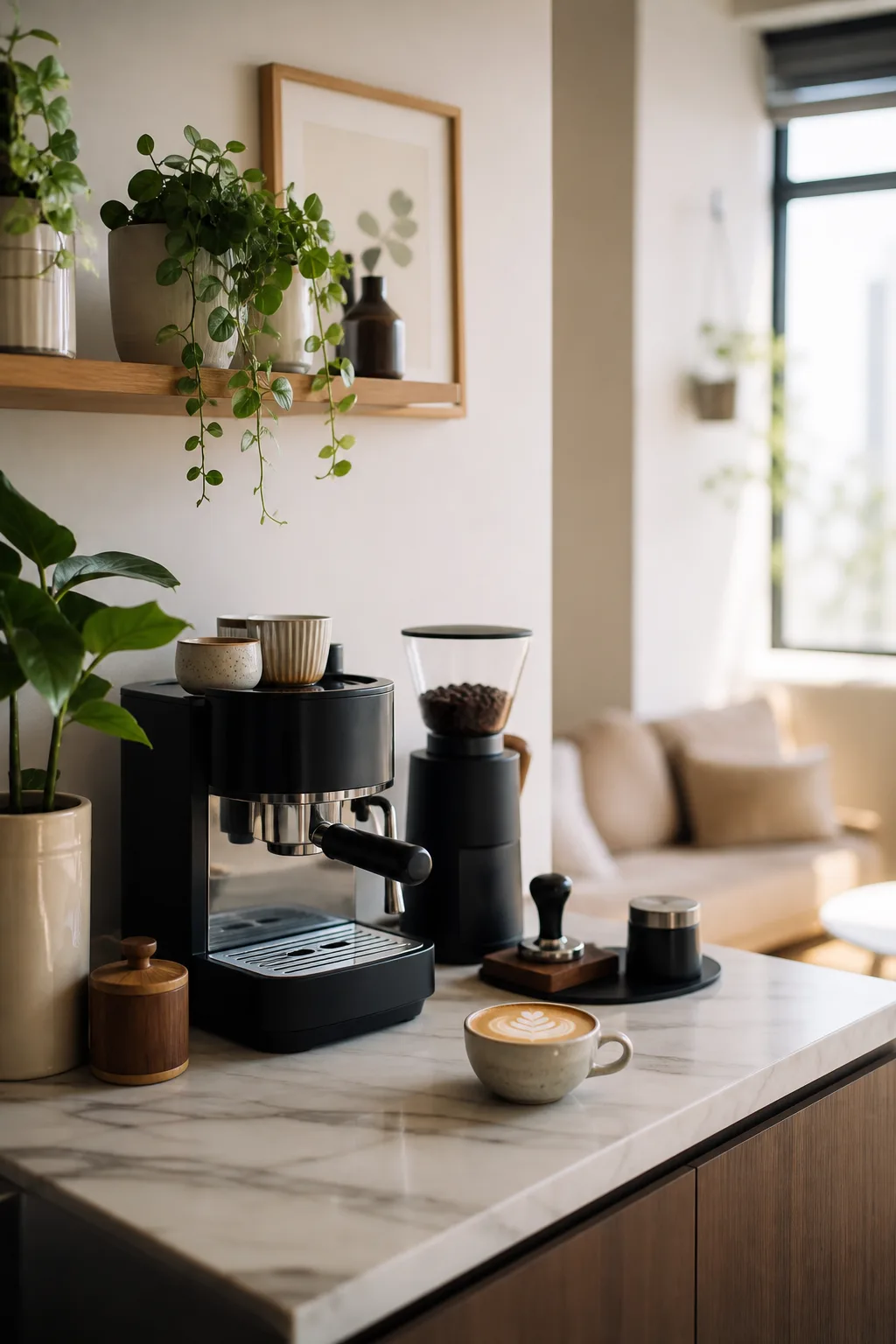
The right apartment coffee setup starts with the drink you make most often—not with a long equipment wish list. Choose one of three paths:
- Manual coffee: smallest footprint and easiest storage.
- Filter coffee: convenient for repeatable mugs or multiple servings.
- Espresso and milk drinks: more equipment, more cleanup and a larger power requirement.
Measure the station only after choosing the path. A machine’s published width is not its full operating footprint: you may need space above it to fill water, in front to remove a portafilter, and beside it for a grinder or kettle.
Start with five apartment constraints
Write down these answers before shopping:
- What drink do you make at least four days a week?
- How much counter width, depth and overhead clearance can stay dedicated to coffee?
- Is there a suitable wall outlet at that location?
- Can you grind and knock out coffee without disturbing someone sleeping or working nearby?
- Where will wet parts dry and used grounds go?
That last question often determines whether a setup survives daily use. A compact machine can still create clutter if the portafilter, milk pitcher and drip tray have nowhere to drain.
Setup A: minimal manual coffee
Choose this route if you make one or two cups at a time, can heat water and want the brewer to disappear into a cabinet after use.
Essential pieces
- Manual brewer
- Burr grinder, unless you buy small amounts of appropriately ground coffee
- Kettle or another controlled hot-water source
- Mug and a small digital scale
- Filters required by the brewer
One measured example is the AeroPress Original. Its U.S. product page lists a 10 oz capacity, dimensions of 5.25 inches high by 4.2 inches wide and a price of $39.95 as of September 2, 2026. The brewer includes paper filters, a stirrer and a scoop. AeroPress also instructs users to press into a sturdy mug or carafe and discourages the inverted method because of hot-liquid tip risk. See the official AeroPress specifications and safety notes.
Pairing it with a filter-oriented Baratza Encore creates a concrete manual setup. Baratza lists the Encore at $149.95, 70 W and 13 × 15 × 34 cm—approximately 5.1 × 5.9 × 13.4 inches. The two listed products total $189.90 before tax and shipping, assuming you already have a suitable way to heat water. Current details are on the Baratza Encore product page.
Why it fits an apartment
The brewer itself stores in a small cabinet, while the grinder is the only item that needs a permanent counter position. Cleanup is concentrated in one filter cap and one mug. The compromise is active work: you heat, measure, stir and press each serving.
If counter space is extremely limited, buy the brewer first and use coffee ground by a local shop for a short trial. Add a grinder only after you know the manual routine fits your mornings.
Setup B: filter-first daily coffee
Choose filter coffee when you want a familiar mug with less hands-on work, or when two people drink coffee at roughly the same time.
Essential pieces
- A drip machine or pour-over brewer sized for your serving volume
- A filter-capable burr grinder
- Filters and a scale or the brewer’s documented measuring system
- An accessible place to fill and clean the water reservoir and basket
For an electric brewer, begin with capacity and operating clearance. A large “12-cup” machine may consume more depth and height than you need. If you normally make one or two mugs, look for a smaller batch option and measure the reservoir lid while open.
The Specialty Coffee Association’s home-brewer certification is one useful screening tool for electric drip machines. Its technical requirements include prescribed water-contact temperatures during the brew cycle. Certification does not tell you whether a brewer is quiet, easy to fill beneath your cabinets or appropriately sized for your household, so treat it as one filter rather than a final ranking. See the SCA certified-home-brewer requirements.
The Baratza Encore above is positioned by its manufacturer for filter brewing and gives you a named grinder example without forcing you into espresso-level adjustment. Keep the brewer and grinder on separate trays if one tends to drip and the other sheds grounds; this makes daily reset faster.
When pour-over is the better filter setup
A dripper and kettle can occupy less permanent space than a drip machine, but they demand more attention. Choose pour-over when you enjoy the process and already own a suitable kettle. Choose an electric brewer when reducing morning decisions matters more than minimizing every inch.
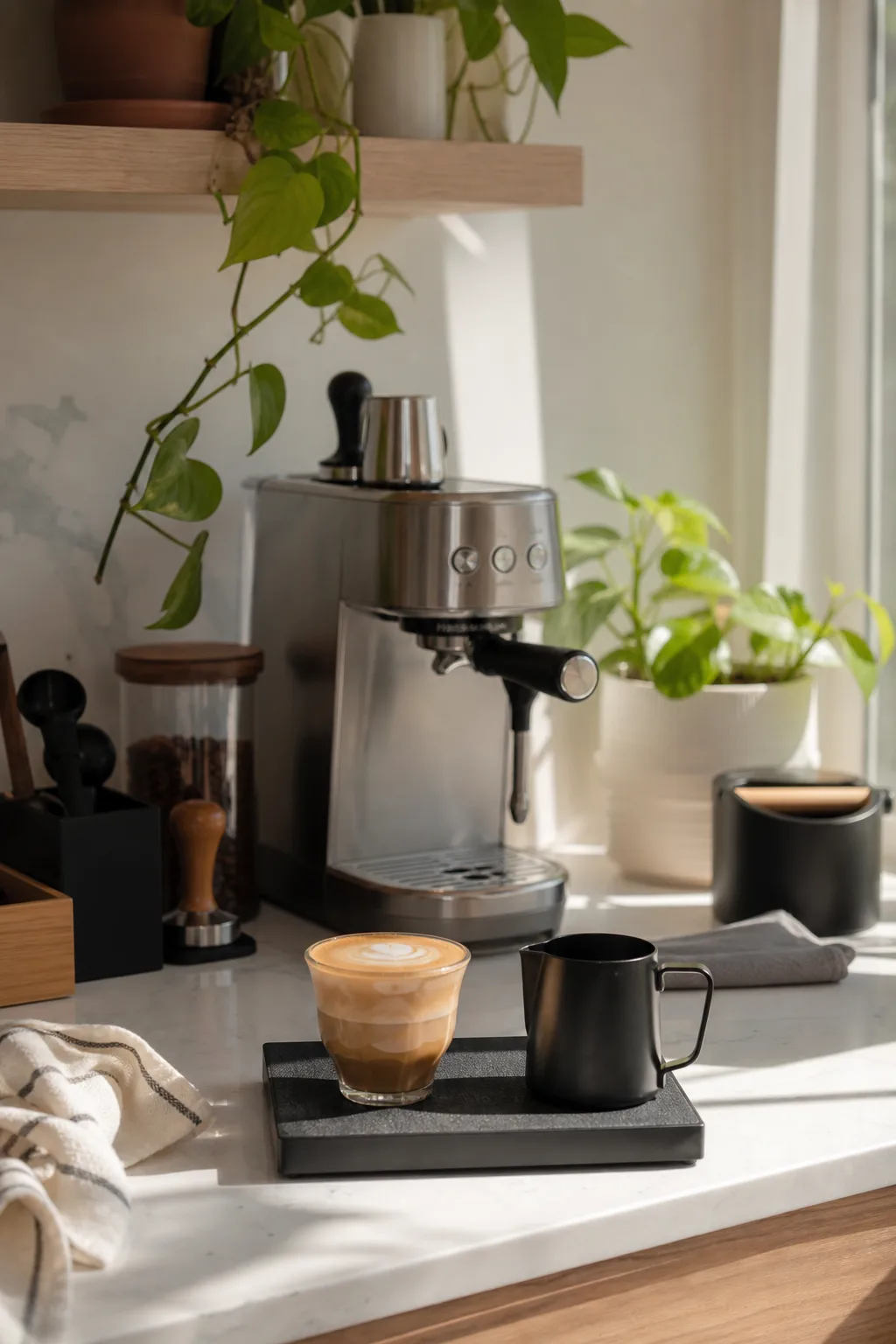
Setup C: compact espresso and milk drinks
Choose this route only if espresso, cappuccinos or lattes are frequent enough to justify the grinder, machine, milk pitcher and cleaning routine.
Essential pieces
- Espresso-capable grinder
- Espresso machine
- Scale that fits the workflow
- Milk pitcher if you steam milk
- Towel or brush and a place for used grounds
A current compact example is the Breville Bambino paired with the Baratza Encore ESP. This is an illustrative configuration based on official specifications, not a tested ranking.
Breville lists the Bambino at $299.95, with dimensions of 6.25 × 13.5 × 12 inches, 110–120 V and 1560 W. The package includes a 54 mm portafilter, single- and dual-wall baskets, milk jug, tamper and cleaning items, which means you do not need to buy duplicate basics on day one. See the Breville Bambino U.S. product page.
Baratza lists the Encore ESP at $199.95, 70 W and 13 × 15 × 34 cm. Its adjustment system assigns settings 1–20 to the espresso range and 21–40 to filter, French press or cold brew; the included dosing cup is designed for 54 mm portafilters and includes a 58 mm adapter. See the Encore ESP specifications.
The listed machine and grinder total $499.90 before tax and shipping as of September 2, 2026. Prices and promotions can change. More importantly, the pair needs roughly two appliance footprints plus working room for tamping, steaming and removing the water tank. Measure the actual counter and overhead space before ordering.
What to postpone
Do not begin with a knock box, distribution tool, bottomless portafilter, premium tamper and a shelf of syrups. Use the accessories included with the machine. After several weeks, add only the item that solves a repeated problem: a grounds container if trips to the trash are disruptive, a better scale if the current one does not fit, or storage if accessories keep spreading across the counter.
Power, noise and water matter more in apartments
Power
The Bambino example is rated at 1560 W, while the two Baratza grinders above are rated at 70 W. Those numbers are not permission to combine appliances on any power strip. Use the outlet and circuit conditions required by each manual. The Electrical Safety Foundation International advises that extension cords should not substitute for permanent wiring, should not serve more than one appliance and must be rated for the connected product. If the planned station requires a permanent extension cord, relocate it or consult your property manager or a qualified electrician.
Noise and timing
Manufacturers do not publish a common, comparable household noise test for these examples, so this guide does not rank them by loudness. In a shared apartment, reduce disruption through workflow: weigh beans before quiet hours, place the grinder on a stable surface, avoid striking a portafilter against a hard trash can, and ask the person in the adjacent room what timing actually bothers them.
Water and cleanup
Keep the station close enough to the sink that filling and rinsing are not chores, but outside the splash zone. Before buying an espresso machine, identify where the drip tray, portafilter and pitcher will dry. Before buying a drip machine, check whether the water reservoir can be removed or filled under the cabinet above it.
Buy in stages
Use this order to avoid an expensive counter full of mismatched tools:
- Choose the drink path. Manual, filter or espresso.
- Measure the operating envelope. Width, depth, open-lid height and working space.
- Buy the brewer and only required consumables. Confirm that the routine fits.
- Add the appropriate grinder. Filter-oriented for manual/filter coffee; espresso-capable for espresso.
- Add workflow tools only after a repeated need appears. Storage, grounds handling and upgraded accessories come last.
There is no universal apartment setup. A manual brewer can be the most complete system for one person, while a compact espresso pair can make sense for someone who prepares milk drinks every morning. The defensible choice is the smallest system that makes your regular drink, fits its full operating envelope and can be cleaned without taking over the kitchen.
Continue reading
Related stories
equipment
Best Espresso Machine for Beginners
equipment
Best Milk Frother Under $50
equipment